
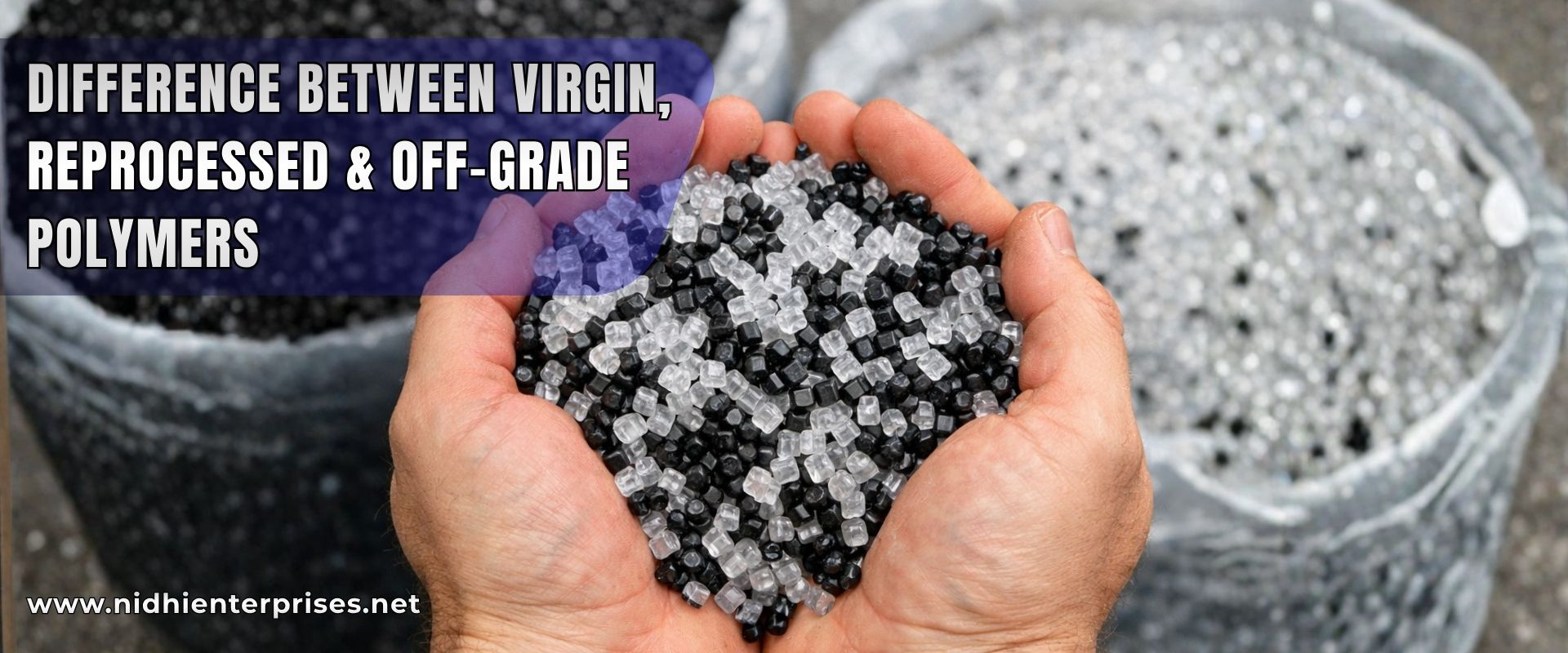
Difference Between Virgin, Reprocessed & Off-Grade Polymers (Complete Guide 2026)
In the polymer industry, three categories of materials are most commonly used: virgin polymers, reprocessed polymers, and off-grade polymers. While these terms are widely used in trading and manufacturing, they are often misunderstood or incorrectly applied during procurement decisions.
A clear understanding of these material types is required to ensure that the correct balance between cost, performance, and quality is achieved. Incorrect selection is frequently associated with production losses, increased rejection rates, and reduced profitability.
This guide by Nidhi Enterprises has been structured to provide a clear and practical breakdown of each category, along with their applications and strategic usage.
What Are Virgin Polymers?
Virgin polymers are defined as materials that are produced directly from petrochemical feaedstock without any prior usage or recycling process. These materials are manufactured under controlled industrial conditions, ensuring consistency in molecular structure and performance.
Due to their purity and predictable properties, virgin polymers are widely used in applications where quality cannot be compromised.
Key Characteristics
High consistency in quality is maintained across batches. Superior mechanical strength and durability are achieved. Contamination is not present, making these materials suitable for food-grade and medical applications.
Applications
Virgin polymers are commonly used in packaging, automotive components, pressure pipes, and consumer goods where regulatory compliance and reliability are required.
For a deeper technical understanding of polymer structures, reference can be made to:
https://www.plasticseurope.org/en/about-plastics/what-are-plastics
What Are Reprocessed Polymers?
Reprocessed polymers are produced by recycling plastic waste, which may include industrial scrap or post-consumer materials. These materials are collected, cleaned, melted, and re-granulated for reuse.
While cost efficiency is achieved, variability in quality is often introduced due to differences in source material and processing techniques.
Key Characteristics
Lower cost compared to virgin polymers is typically observed. Variability in properties may be present. Mechanical strength is usually reduced when compared to virgin material.
Applications
Reprocessed polymers are generally used in non-critical applications such as containers, furniture, and low-pressure products where slight performance variation can be tolerated.
Additional recycling insights can be explored here:
https://www.bpf.co.uk/plastipedia/recycling
What Are Off-Grade Polymers?
Off-grade polymers are materials that do not meet standard manufacturing specifications but remain usable for certain applications. These materials may have slight deviations in parameters such as Melt Flow Index (MFI), color, or density.
These deviations are usually caused during production runs and are sold at discounted prices.
Key Characteristics
Lower pricing is offered compared to virgin material. Minor inconsistencies in quality may be present. Performance is dependent on application compatibility.
Applications
Off-grade polymers are used in cost-sensitive manufacturing where strict specifications are not required. These materials are often preferred by experienced buyers who understand how to optimize usage.
For material data comparisons, refer to:
https://www.matweb.com
Key Differences Between Virgin, Reprocessed & Off-Grade Polymers
The primary differences are observed in quality, cost, consistency, and application suitability.
Virgin polymers are characterized by high quality and consistency but are priced higher. Reprocessed polymers offer cost advantages but introduce variability. Off-grade polymers provide a middle ground, offering reduced pricing with acceptable performance in suitable applications.
A detailed comparison of polymer properties can also be explored here:
https://www.polymerdatabase.com
Pricing Comparison and Market Behavior
Pricing differences between these materials are influenced by crude oil prices, availability, and demand.
Virgin polymers are directly linked to petrochemical pricing trends. Global crude oil benchmarks can be tracked here:
https://www.eia.gov
Reprocessed polymers are influenced by waste availability and recycling efficiency. Off-grade polymers are typically priced based on surplus availability from manufacturers.
In most cases, higher margins are observed in reprocessed and off-grade trading compared to virgin materials.
How to Choose the Right Polymer for Your Business
The selection of the appropriate material should be based on application requirements, cost targets, and quality expectations.
It is recommended that application-specific analysis be conducted before procurement decisions are finalized. Sample testing should always be performed to validate performance.
For a complete understanding of HDPE material selection, refer to our detailed guide:
https://nidhienterprises.net/product/hdpe-granules/
Common Mistakes in Polymer Selection
A price-focused approach is often adopted without considering application requirements. Technical parameters such as MFI are frequently ignored. Supplier verification is not always conducted.
These mistakes are commonly associated with production inefficiencies and financial losses.
Conclusion
A clear distinction between virgin, reprocessed, and off-grade polymers must be understood before any procurement decision is made. Each material type has its own advantages and limitations, and the correct selection can significantly impact business outcomes.
When approached strategically, polymer sourcing can be optimized for both cost efficiency and performance.
About Nidhi Enterprises
At Nidhi Enterprises, expertise in polymer sourcing, trading, and export operations is leveraged to provide reliable material solutions. As a trusted supplier in LDPE, HDPE, PP, masterbatches, and recycled polymers, consistent quality and global supply capability are ensured for industrial buyers. A strong focus is maintained on quality, consistency, and long-term business relationships.
For inquiries and supply support:
https://nidhienterprises.net