
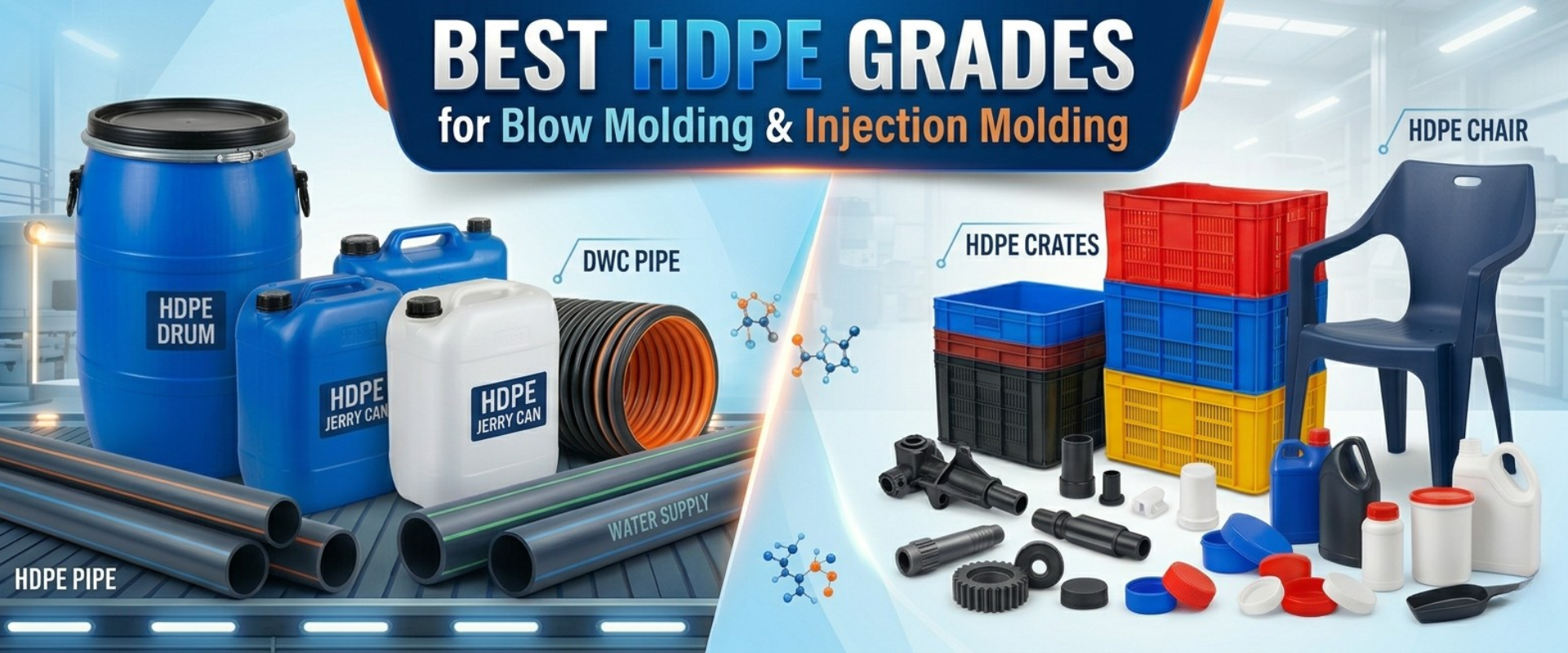
Best HDPE Grades for Blow Molding & Injection Molding
In today’s competitive plastics industry, choosing the correct HDPE grades for molding can directly impact product quality, production efficiency, rejection rates, and overall manufacturing cost.
Whether you manufacture bottles, drums, caps, crates, automotive components, household products, or industrial containers, selecting the right High-Density Polyethylene (HDPE) grade is critical for achieving consistent performance.
At Nidhi Enterprises, we work closely with manufacturers, processors, and OEMs across India to help businesses select suitable polymer grades based on application, machine compatibility, and commercial feasibility.
This guide explains the best HDPE grades used for blow molding and injection molding, including their properties, applications, and selection criteria.
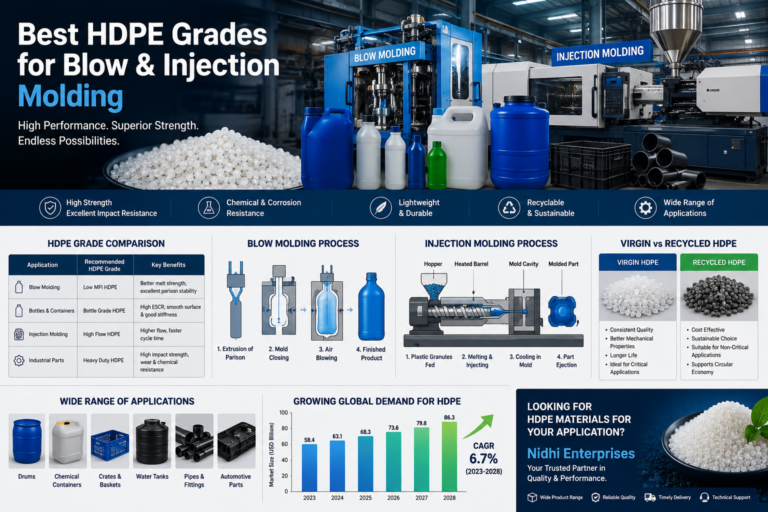
What is HDPE?
High-Density Polyethylene is a strong, lightweight, and versatile thermoplastic polymer widely used in industrial and commercial manufacturing.
HDPE is known for:
- High strength-to-density ratio
- Excellent chemical resistance
- Moisture resistance
- Durability
- Good impact strength
- Cost-effective processing
Due to these properties, HDPE is heavily used in both blow molding and injection molding industries.
If you want to understand broader polymer applications and industrial usage, you can also explore HDPE vs PP vs LLDPE Guide.
Understanding HDPE Grades for Molding
Different manufacturing processes require different HDPE material characteristics.
The major difference between HDPE grades usually depends on:
- Melt Flow Index (MFI)
- Density
- Impact resistance
- Environmental stress crack resistance (ESCR)
- Stiffness
- Processing behavior
Manufacturers should always select grades based on product application rather than simply choosing the lowest-cost material.
For businesses trying to optimize procurement strategy and raw material selection, reading How Polymer Pricing Works can also help understand how crude oil, imports, and market demand affect polymer pricing.
HDPE Grades for Blow Molding
Blow molding is commonly used to manufacture hollow products such as bottles, drums, containers, tanks, and cans.
During this process, the material must offer:
- Good melt strength
- Uniform wall thickness
- High impact resistance
- Strong ESCR properties
Common Applications of Blow Molding HDPE
- Chemical containers
- Milk bottles
- Shampoo bottles
- Lubricant containers
- Water storage cans
- Industrial drums
- Jerry cans
Best HDPE Grades for Blow Molding
1. HDPE BM Grade (Low MFI)
Low MFI HDPE grades are widely preferred for large blow-molded products because they provide better melt strength and dimensional stability.
Typical applications include:
- Industrial containers
- Water tanks
- Large drums
- Chemical storage products
Benefits include:
- Better impact strength
- Improved rigidity
- Lower deformation risk
Businesses looking for industrial-grade polymer sourcing solutions can connect directly through Nidhi Enterprises Contact Page.
2. HDPE High ESCR Grades
High ESCR grades are used where products are exposed to chemicals, detergents, oils, or environmental stress.
These grades are commonly used in:
- Chemical packaging
- Agrochemical containers
- Lubricant bottles
- Industrial chemical drums
Advantages:
- Crack resistance
- Longer product life
- Better chemical durability
You can also learn more about polymer supplier selection and procurement risk management through How to Choose the Right Polymer Supplier.
3. HDPE Bottle Grades
Bottle-grade HDPE offers balanced processability and stiffness for fast production cycles.
Applications include:
- FMCG bottles
- Cosmetic bottles
- Pharmaceutical containers
- Food packaging
These grades support:
- Faster cycle times
- Smooth surface finish
- Lightweight bottle manufacturing
HDPE Grades for Injection Molding
Injection molding requires HDPE grades with good flowability and fast processing capability.
In this process, molten plastic is injected into a mold cavity under pressure.
Therefore, injection molding grades generally use:
- Medium to high MFI
- Better flow properties
- Faster cooling behavior
Common Applications of Injection Molding HDPE
- Crates
- Buckets
- Caps & closures
- Pallets
- Household products
- Automotive components
- Furniture parts
Best HDPE Grades for Injection Molding
1. High Flow HDPE Grades
High-flow HDPE grades are ideal for thin-wall products and high-speed manufacturing.
Applications:
- Caps
- Closures
- Food containers
- Thin-wall packaging
Benefits:
- Faster filling
- Reduced cycle time
- Better mold replication
2. Medium MFI HDPE Grades
Medium-flow grades provide balanced strength and processability.
They are commonly used in:
- Buckets
- Crates
- Household containers
- Industrial utility products
Advantages include:
- Good stiffness
- Better impact strength
- Consistent dimensional accuracy
For manufacturers exploring cost optimization using virgin and reprocessed materials, you can read Virgin vs Reprocessed Polymer Guide.
3. Heavy-Duty Injection Grades
Heavy-duty HDPE grades are designed for industrial products requiring toughness and durability.
Applications:
- Pallets
- Automotive parts
- Industrial bins
- Furniture components
These grades provide:
- High load-bearing capacity
- Improved structural integrity
- Long-term durability
How to Select the Right HDPE Grade
Choosing the right HDPE grades for molding depends on several technical and commercial factors.
1. Product Application
The first consideration should always be the end-use application.
For example:
- Chemical packaging requires high ESCR
- Thin-wall products require high flow
- Industrial containers need better stiffness
2. Machine Compatibility
Different molding machines perform differently with varying MFI ranges.
Manufacturers should ensure:
- Proper machine temperature
- Screw compatibility
- Suitable cycle timing
Incorrect grade selection can lead to:
- Flow marks
- Product shrinkage
- Warpage
- Rejection increase
For technical polymer consultation and industrial sourcing support, manufacturers can directly visit Nidhi Enterprises Official Website.
3. Production Speed
Some HDPE grades allow:
- Faster cooling
- Faster cycle time
- Higher output efficiency
This becomes important for high-volume manufacturers.
4. Commercial Viability
Many manufacturers focus only on price per kilogram.
However, actual profitability depends on:
- Rejection percentage
- Production efficiency
- Product durability
- Processing stability
Sometimes a slightly premium-grade material reduces overall production cost significantly.
To better understand procurement mistakes manufacturers commonly make, you can also read Common Polymer Buying Mistakes.
Virgin vs Reprocessed HDPE for Molding
Many manufacturers today also use reprocessed HDPE material for cost optimization.
However, material selection should depend on product category and quality expectations.
Virgin HDPE
Virgin HDPE offers:
- Consistent quality
- Better strength
- Stable processing
- Superior finish
It is ideal for:
- Food-grade products
- FMCG packaging
- Premium industrial applications
Reprocessed HDPE
Reprocessed HDPE can help reduce manufacturing cost when used correctly.
Applications may include:
- Non-critical industrial products
- Utility products
- Secondary packaging
However, manufacturers must carefully evaluate:
- Melt consistency
- Contamination level
- Odor
- Mechanical strength
At Nidhi Enterprises, we help manufacturers identify suitable virgin, off-grade, and reprocessed polymer solutions based on technical and commercial requirements.
Current Market Demand for HDPE Molding Grades
The Indian plastics industry continues to see strong demand for HDPE molding materials due to growth in:
- Packaging industry
- FMCG sector
- Automotive manufacturing
- Agriculture applications
- Infrastructure development
Manufacturers are increasingly focusing on:
- Cost optimization
- Stable raw material supply
- Better processing efficiency
- Technical-grade selection
As a result, selecting the right HDPE grade has become more important than ever.
For global polymer industry insights and plastics processing trends, you can refer to Plastics Industry Association and Britannica HDPE Overview.
Why Manufacturers Work with Nidhi Enterprises
At Nidhi Enterprises, we support manufacturers with:
- HDPE grade selection support
- Virgin and reprocessed polymer sourcing
- Commercial-grade recommendations
- Bulk supply assistance
- Technical consultation
- Pan-India supply support
We understand that every manufacturer has different machine setups, production challenges, and margin requirements.
Therefore, our approach focuses on practical industrial solutions instead of generic material selling.
Final Thoughts
Selecting the right HDPE grades for molding is not only a technical decision but also a commercial one.
The correct material can improve:
- Production efficiency
- Product quality
- Processing stability
- Customer satisfaction
- Manufacturing profitability
Whether you are involved in blow molding or injection molding, proper HDPE grade selection can significantly impact your business performance.
If you are looking for suitable HDPE materials for your manufacturing requirements, connect with Nidhi Enterprises for sourcing assistance, technical consultation, and industrial polymer support.